|
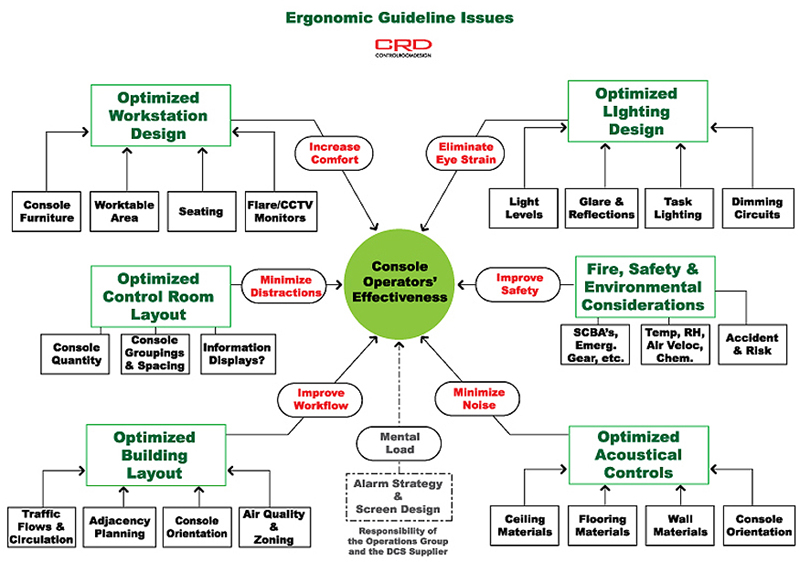
HUMAN FACTORS/ERGONOMICS: Key to the layout of a control building and control
room are the key ergonomic issues that directly effect the Operators (shown above). Our planning and ergonomic studies
include: site requirement studies; blast radius studies if/as required; personnel, task and operational analysis; traffic
flow and adjacency studies; unit-to-console arrangement flow diagrams and planning; console layout and accessory planning;
emergency equipment plannning; glare & reflection studies; and detailed lighting design and fixture specification.
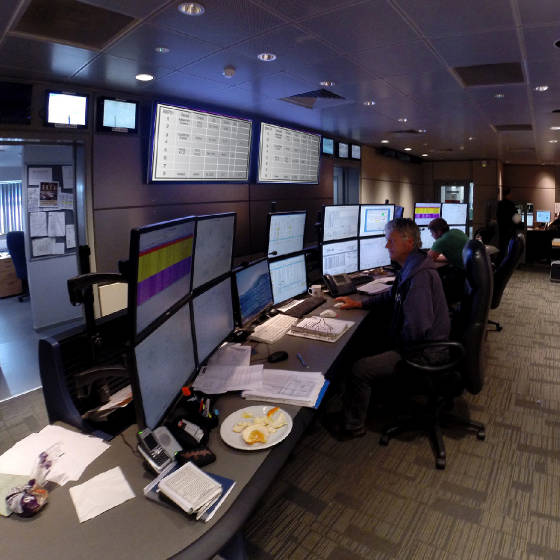
Often
times, upgrades need to happen in small control room areas - such as in this Valero 'blending & shipping' control room
in Wales. The consoles must provide: appropriate number and positioning of screens and keyboards; legible and understandible
graphics; immediate access to communication handsets; plenty of clear workspace for paperwork (oftentimes lunch); and complete
control over individual levels of lighting.
|
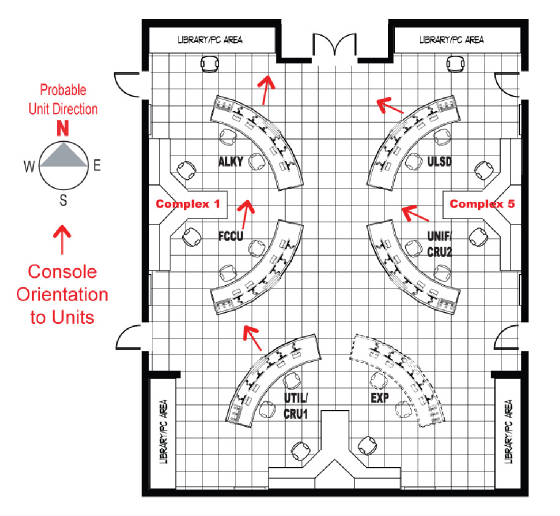
Whereas
the process of a refinery follows a prescribed flow, so should the location and adjacencies of the consoles. And the consoles
should generally 'face' the direction of the process under control to minimize 'mirror imaging' errors. Widely accepted
ergonomic practice is to have the consoles positioned for left-to-right flow of the process, with closely related process
units situated within a sector, or close grouping of consoles. Consoles controlling units such as Utilities, Oil Movements,
SRU, etc. can often reside in non-adjacent locations.
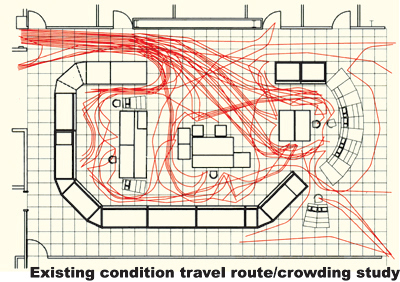
This
traffic flow study, of an older 'existing' control room in Bayway, NJ, shows actual traffic routes measured during a typical
1/2 hour shift-change period. Having all this traffic to the 'backs-of-all-Operators' is a significant distraction.
Another often overlooked human factors issue is positioning of the consoles in the control room, with respect to the process
units under control.
|